
Insurance industry veteran Chris Cline, executive director of the Agents Council for Technology of the Independent Insurance Agents and Brokers of America, holds a passion for the health of the insurance industry and how technology can help independent agencies and carriers succeed. On the side, he likes to think and read about science.
Chris says he “grew up in a family environment where I was encouraged to think and test and understand … why things work.” From his grade school days, he was enthralled with physics, earth science and geology, and later became “infinitely fascinated” by astronomy and astrophysics.
“I don't have anywhere near enough intellectual horsepower to pursue [these fields] professionally,” he confesses. “I'm very much an armchair, novice version of a science geek.” That backdrop makes it interesting that he ended up majoring in fine arts in college, perhaps showing he could bounce between art and science, and connect seemingly disparate dots.
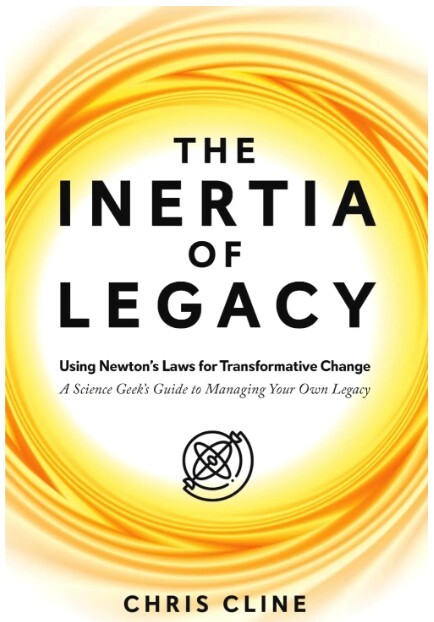
He’s stepped out of his professional role, returned to his childhood passion for science, and coupled that passion with his personal and professional interests with a new book: The Inertia of Legacy: Using Newton's Laws of Transformative Change — A Science Geek’s Guide to Managing Your Own Legacy (is there a scientific law that book titles must be long?). Tangentially related to his career in insurance (note: the book is not affiliated with ACT), Chris’s book takes on two words I’ve long been fascinated with: inertia and legacy. And he turns them on their heads.
Cline’s scientific muse, the physicist and mathematician Isaac Newton — famous for an apocryphal story about an apple falling on his head — proposed (discovered?) three laws of motion in 1687: inertia, force, and action and reaction.
The law of inertia specifies that a body at rest or moving at a constant speed in a straight line will continue at rest or moving at a constant speed unless it is acted upon by a force. While The Inertia of Legacy isn’t expressly about insurance, the concept of inertia applies to the industry: This long-running business tends to continue the way it’s going (or not going) until someone changes something.
That brings me to the term “legacy” — another term I’ve heard for decades in the business. By one definition, “legacy systems are those aging and obsolete business tools that are still in use.” Legacy systems stick around because the cost-benefit analysis of replacing them doesn’t work.
So legacy leads back to inertia. Right, Chris?
“I was thinking about it: If you don't like the way something’s done or the path you’re on, we can all do something about change. A few years ago I was reading or listening to something about Newton's laws and it hit me that, hey, there’s this thing called inertia. And if nothing happens to an object at rest or in motion, it’s going to stay in motion or at rest.”
Sounds like a proverbial apple dropped on the author’s head while he was in the orchard.
“These weird ideas were bouncing around in my head and I thought: We can be our own inertia. It clicked. I started to think more intently about this concept of physics principles and personal lives,” Chris explains.
Inertia and legacy can have negative connotations. Inertia can mean we as an industry and as professionals keep doing things even if they’re not optimal, because we’re accustomed to doing them. It also implies that given the number of forces at play in the world, there is no guarantee of sustained momentum.
Legacy also has been used as jargon for technology, businesses, business practices and even people that are old and out of date, perceived to be past their prime. But both terms also can have powerful connotations with approached with intent and passion, Chris argues.
Spoiler alert about the book: “I do a rant on trying to reclaim the word ‘legacy’ [for the insurance industry] and attempt to put a positive spin back on the concept,” Chris says.
As Chris puts it: “There’re these forces at play, whether we’re paying attention to them or not, that are defining the path we’re on … whether you are happy or unhappy with the path you’re on, you can do something about it.” Or: “Even if you're thrilled with the path you’re on, there are forces at play all the time that are continually working against that and can alter your trajectory if you’re not paying attention to and working to mitigate them.”
For me, Chris’s book points out that inertia and legacy have other sides besides those negative connotations. Inertia is a good thing; it keeps things going forward. Legacy is this thing people leave behind for others, whether it’s a financial legacy or business or a family.
Inertia and legacy apply to the insurance business, particularly independent agencies. His takeaway for the industry: Don’t “become overly comfortable or overly critical with where you are in your trajectory, because wherever you are, there are always internal and external forces working to keep you where you are and to knock you off of the trajectory.
“Spend some time and understand exactly where you are and where you want to be and what forces you can identify and use …” Chris concludes, “to keep you where you are if you're happy, but also to manipulate or to move and influence if you’re not happy with where you are,”.
Okay, enough scientific talk about inertia and legacy. Let’s get back to insurance.